If you run an industrial facility — whether it’s a paint shop, a food processing plant, a metal finishing unit, or a refinery — you already know that wastewater doesn’t clean itself. Suspended solids, oils, greases, and fine particulates can wreck your downstream treatment systems, spike your discharge costs, and land you on the wrong side of pollution control norms.
That’s exactly where DAF comes in.
Dissolved Air Flotation, commonly known by its abbreviation DAF, has quietly become one of the most reliable and widely adopted technologies for industrial wastewater clarification. It’s not new — the concept has been around for over a century — but recent advances in microbubble generation, compact system design, and energy efficiency have made DAF systems more practical and accessible than ever, especially for small and mid-sized Indian manufacturing plants.
In this guide, we’ll break down what DAF means, how it works, where it fits in your treatment train, and what to look for when evaluating a DAF system for your facility.
What Is DAF? Understanding the Full Form and Meaning
DAF stands for Dissolved Air Flotation. At its core, it’s a water treatment process that removes suspended solids, oils, greases, and other contaminants from wastewater by using tiny air bubbles to float them to the surface.
Think of it this way: instead of waiting for particles to settle to the bottom (which is how a conventional clarifier works), a DAF system forces those particles upward by attaching microscopic air bubbles to them. The bubble-particle clusters rise to the surface, forming a concentrated sludge layer — called the “float” — which is then skimmed off mechanically.
This makes DAF especially effective for particles that are too light to settle efficiently on their own, such as fats, oils, algae, fine suspended solids, and flocculated chemical precipitates.
How Does a DAF System Work? The Process Step by Step
A typical DAF system in wastewater treatment follows a straightforward sequence, though the engineering behind each step matters enormously for performance.
- Chemical conditioning is usually the first step. The incoming wastewater is dosed with a coagulant — often ferric chloride, aluminium sulphate, or poly-aluminium chloride — to neutralise the electrical charges on fine suspended particles. A polymer flocculant may also be added to bind these destabilised particles into larger clusters, or flocs. Getting the chemistry right at this stage is arguably the single biggest factor in DAF performance.
- Pressurisation and air dissolution is where the “dissolved air” part happens. A portion of the treated effluent (the recycle stream) is pumped into a pressurised vessel called a saturator, where compressed air is forced into the water at pressures typically between 4 and 6 bar. Under this pressure, the water absorbs far more air than it normally could at atmospheric conditions — it becomes supersaturated.
- Bubble release and flotation occur when this air-saturated recycle water is released into the flotation tank through a pressure-reduction valve. The sudden drop in pressure causes the dissolved air to come out of solution as clouds of extremely fine microbubbles, generally in the 30 to 70 micron range. These bubbles collide with and attach to the flocculated particles, making the combined particle-bubble aggregates buoyant enough to rise rapidly to the surface.
- Skimming and sludge removal is the final step. The floating sludge blanket on the surface is continuously removed by a mechanical skimmer — typically a paddle, chain-and-flight, or rotating arm mechanism — and directed to a sludge hopper for further dewatering or disposal. Clean clarified water exits from the bottom of the tank.
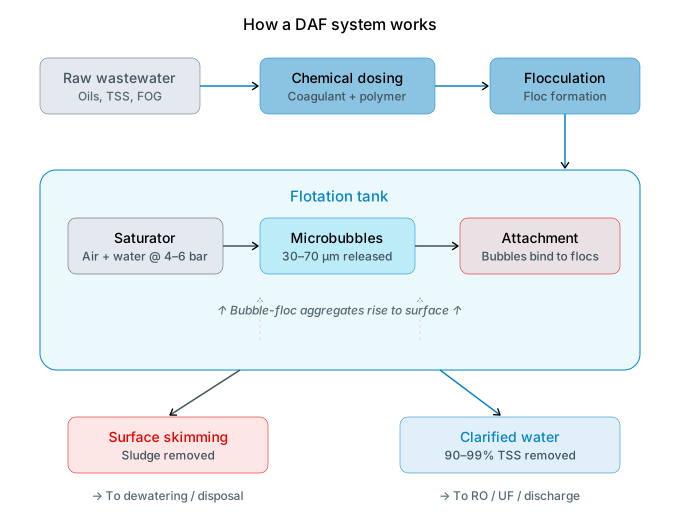
The entire flotation process takes only a few minutes, which is one of the reasons DAF systems can be significantly more compact than gravity-based clarifiers handling the same flow rate.
DAF vs. Sedimentation: Why Flotation Often Wins
Traditional sedimentation relies on gravity and time. Particles settle slowly to the bottom of a large basin, and the process can take hours. For heavy, dense solids, sedimentation works well enough. But many industrial wastewater streams contain contaminants that simply don’t settle easily — light oils, colloidal matter, fine emulsions, and biological solids with near-neutral buoyancy.
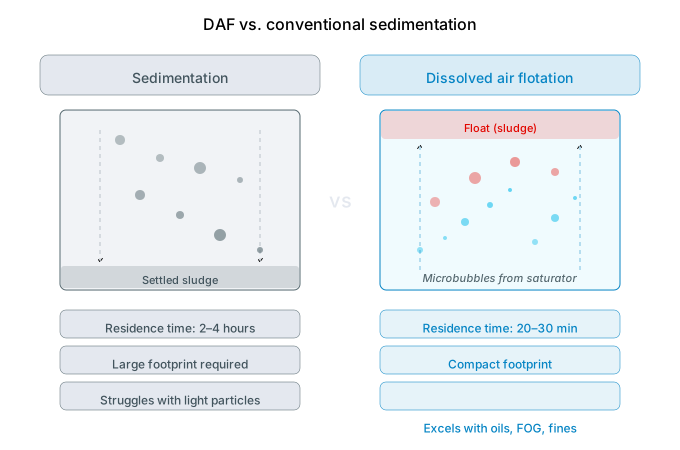
DAF flips the approach. By actively lifting particles with microbubbles, DAF dramatically reduces the residence time required for clarification. Where a conventional clarifier might need 2 to 4 hours, a well-designed DAF unit achieves comparable or better removal in 20 to 30 minutes. This translates directly into a smaller physical footprint — a critical advantage for Indian plants where space is often at a premium.
DAF systems also handle variable loads more gracefully than gravity settlers. If your process generates fluctuating wastewater quality — which is common in batch operations like metal finishing or food processing — a DAF system with proper chemical dosing can adapt far more quickly than a sedimentation basin.
The trade-off is energy. DAF requires power for the recycle pump, the air compressor, and the skimming mechanism. However, for facilities dealing with oils, greases, or light suspended solids, the improved removal efficiency and smaller footprint usually justify the energy cost many times over.
Where Is DAF Technology Used? Key Industry Applications
Dissolved Air Flotation is one of the most versatile clarification technologies available. Its applications span a wide range of sectors.
- In automotive and metal finishing, DAF systems are commonly used to treat phosphating wastewater, paint shop effluent, and oily rinse water. These streams carry a combination of suspended solids, heavy metals, and emulsified oils that are difficult to remove with conventional settling alone.
- The food and beverage industry generates high volumes of wastewater loaded with fats, oils, greases (FOG), and organic suspended solids. DAF is highly effective here, often achieving 90% or higher removal of FOG and TSS in a single pass.
- Refineries and petrochemical plants use dissolved gas flotation — a close cousin of DAF that substitutes nitrogen for air to avoid explosion risks — to separate hydrocarbons from process water. The target is typically to bring oil concentrations below 25 ppm.
- In pulp and paper mills, DAF recovers fibre from process water and reduces BOD and COD loads before biological treatment. The technology has been a staple in this sector for decades.
- Municipal water treatment plants use DAF for drinking water clarification, especially in regions dealing with algal blooms or water sources with low turbidity but high colour. DAF can remove algae far more effectively than conventional flocculation and sedimentation.
DAF also serves as an effective pre-treatment step for membrane systems such as ultrafiltration (UF) and reverse osmosis (RO). By removing suspended solids and colloidal matter upstream, DAF significantly reduces membrane fouling, extends membrane life, and lowers maintenance costs — an approach that Sarvo Technologies regularly integrates into its treatment trains.
Key Design Considerations for a DAF System
If you’re evaluating a DAF system for your facility, there are several design parameters that directly affect performance.
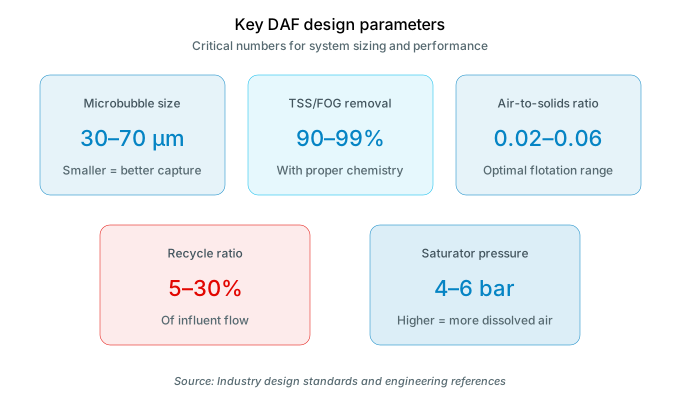
- Hydraulic loading rate determines how much wastewater the system can process per unit of surface area. Typical rates range from 5 to 15 m³/m²/hour, depending on the application and contaminant characteristics. Overloading the system reduces bubble-particle contact time and impairs separation.
- Air-to-solids ratio (A/S) is one of the most important design variables. It defines how much dissolved air is available relative to the mass of solids entering the system. Industry experience suggests optimal A/S values fall between 0.02 and 0.06. Too little air means insufficient flotation; too much creates turbulence from coalescing bubbles, which disrupts the float layer.
- Recycle ratio — the fraction of treated effluent that is recirculated through the saturator — typically ranges from 5% to 30% of the influent flow. Higher recycle ratios provide more air but increase pumping energy.
- Chemical selection and dosing is where pilot testing becomes essential. The right coagulant, the right polymer, and the right dose depend entirely on your specific wastewater characteristics. Jar testing is the standard first step, and any reputable DAF supplier should conduct or support this as part of system sizing.
- Bubble size matters more than most people realise. Smaller microbubbles offer greater surface area for attachment and better capture efficiency, particularly for fine particles. Sarvo’s DAF modules use a compact microbubble generator engineered around three hydrodynamic principles — negative pressure air-water suction, effective air-water mixing, and pressurised air-enriched discharge — to consistently produce fine, uniform bubbles that maximise separation performance.
What Makes Sarvo’s DAF Systems Different?
Sarvo Technologies Limited has been building water and wastewater treatment solutions since 1991. As an ISO 9001:2018 certified company and part of the Indo Autotech Group, Sarvo brings deep manufacturing expertise and a commitment to practical, reliable engineering.
Sarvo’s DAF modules are designed around a uniquely compact microbubble generator that forms the heart of an efficient plant layout. The saturation pump uses a precision mechanism to simultaneously draw in air and water, mix them effectively, and produce pressurised air-enriched discharge — all in a single unit. This air-enriched water is transferred into the flotation tank, where microbubbles spread uniformly from the bottom upward, forming a stable sludge mat at the surface for clean skimming.
The result is a DAF system that is compact, energy-efficient, and engineered for the kind of real-world operating conditions Indian industrial plants actually face — variable loads, limited space, and the need for low-maintenance operation.
Sarvo integrates DAF into larger treatment architectures alongside technologies like electrocoagulation, UF, RO, MVR evaporation, and Zero Liquid Discharge systems, providing end-to-end solutions for industries ranging from automotive paint shops and fertiliser manufacturing to pharmaceuticals and metal processing. Clients like IFFCO, Hindalco, Foxconn, Hero, and JBM trust Sarvo to deliver treatment systems that work — day in, day out.
Frequently Asked Questions (FAQs)
What does DAF stand for in water treatment?
DAF stands for Dissolved Air Flotation. It is a physical-chemical treatment process that uses pressurised microbubbles to float suspended solids, oils, and greases to the water surface for removal.
How is DAF different from sedimentation?
Sedimentation relies on gravity to settle heavy particles to the bottom of a basin. DAF actively floats particles upward using microbubbles, making it far more effective for light contaminants like oils, greases, and fine suspended solids — and significantly faster.
What industries benefit most from DAF systems?
Food and beverage, automotive paint shops, metal finishing, pulp and paper, pharmaceuticals, petrochemicals, and municipal water treatment are among the most common applications. Any process generating oily or high-TSS wastewater is a strong candidate.
Can a DAF system help with oil separation from water?
Yes. DAF is one of the most effective water and oil separation methods for industrial wastewater. The microbubbles attach to oil droplets and emulsified hydrocarbons, lifting them to the surface where they are skimmed off.
What is the typical removal efficiency of a DAF system?
Well-designed DAF systems routinely achieve 90–99% removal of total suspended solids (TSS) and fats, oils, and greases (FOG), depending on influent characteristics and chemical pre-treatment.
Does DAF require chemical dosing?
In most applications, yes. Coagulants and flocculants are added upstream to condition the wastewater and create flocs that microbubbles can effectively attach to. The specific chemicals and dosages are determined through jar testing.
Is DAF suitable as pre-treatment for RO and UF membranes?
Absolutely. DAF is increasingly used as a pre-treatment step to protect membrane systems from fouling. By removing particulate matter and colloids upstream, DAF extends membrane life and reduces cleaning cycles.